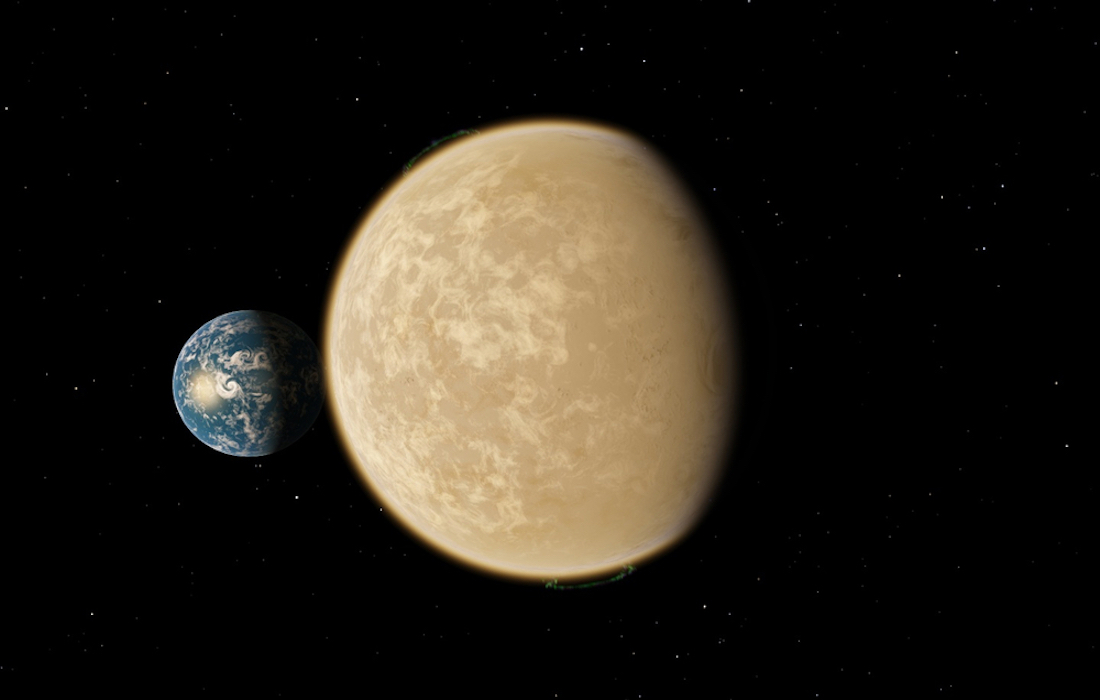
A new study shows that astronomers and scientists have spotted evidence of an exoplanet circling a super-dense corpse known as a white dwarf, for the first time ever. Study lead author Boris Gaensicke, from the University of Warwick in England, said: “This discovery is great progress because, over the past two decades, we had growing evidence that planetary systems survive into the white-dwarf stage,”.
Gaensicke further added that “We’ve seen a lot of asteroids, comets and other small space objects hitting white dwarfs”.
The vast majority of stars in the Milky Way galaxy will end up as white dwarfs. When all of these stars run out of their nuclear fuel, first, they will bloat up as swollen red giants and then eventually break down into the white dwarfs, which pack about one solar mass into the sphere size of the planet Earth. The main exception is really big stars, that bear approx. eight times the mass of the sun. These beasts go supernova when they end, and their remains normally end up as neutron stars or black holes, objects even denser and more exotic than white dwarfs. Gaensicke and his fellow astronomers studied a white dwarf termed as WDJ0914+1914, which lies about 2,040 light-years from the planet Earth. In data gathered by the Sloan Digital Sky Survey, the researchers figured out hydrogen, sulfur, and oxygen emissions coming from white dwarf, WDJ0914+1914. For a white-dwarf system, that’s an odd combination of gases. The VLT observations confirmed all three elements were present and suggested that the emissions are coming from a ring of gas around the white dwarf WDJ0914+1914.

New studies
The new study was published online on 4th December in the journal Nature. In a companion paper also published on the same date, in the Astrophysical Journal Letters, Schreiber, Gaensicke, and colleagues investigated that what will happen in our own solar system when the sun will exhaust its own nuclear fuel about 4.5 billion years from now, swelling into a red giant that engulfs Mercury, Venus and likely Earth as well.
The researchers determined that the white dwarf that the sun becomes is likely to emit enough high-energy photons to evaporate Jupiter, Saturn, and Uranus and Neptune eventually, and some of those planets’ constituent gases may be detectable by any alien astronomers who may be around and observing our system at that time.