
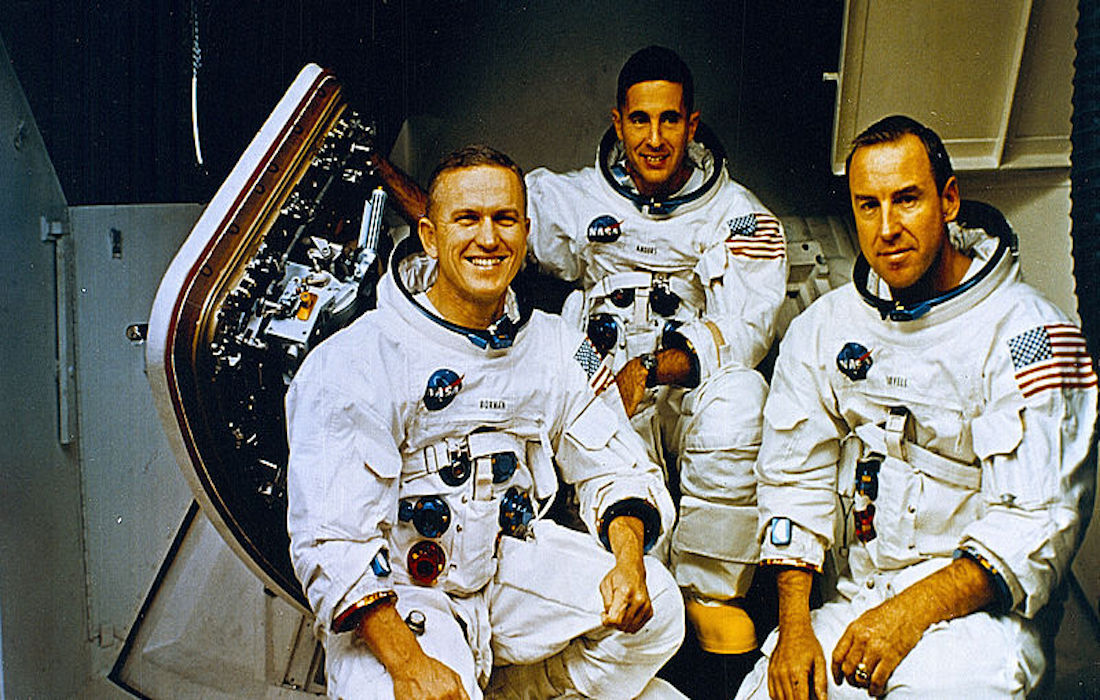
In December 1968, the Apollo 8 mission was a major step towards space exploration as it was the first time when humans went beyond the Earth orbit. The 6-day fight of the 3-men crew set the stage for men landing on the moon, the following summer.
The mission also seemed to serve a meaningful purpose for society beyond the astounding engineering achievement. In 1968, America witnessed a bitter presidential election, assassinations, riots, and seemingly endless violence in Vietnam, and a protest against the war. And at the same time, Americans watched a live broadcast where three NASA astronauts appeared on the moon on Christmas Eve.

Moving Forward from disaster
In November 1966, until the final flight, the two-man capsule Gemini 12, of Project Gemini kept returning to space. Project Apollo, the most ambitious American space program was in the works with the first flight scheduled launch off in early 1967.
NASA, unfortunately, got into controversies over the construction of the Apollo capsules. The contractor, McDonnell Douglas Corporation, who built the Gemini capsules, had performed well but was not able to handle the workload to also build the Apollo capsules. The Apollo contract was awarded to North American Aviation, which had experience in building unmanned space vehicles. Engineers from North American clashed repeatedly with NASA astronauts.
On January 27, 1967, disaster struck. The three astronauts assigned to fly aboard Apollo 1, were conducting a flight simulation in the space capsule John F. Kennedy Space Center. Suddenly, a fire broke out in the capsule. The three men were unable to open the hatch and came out of the capsule before dying of asphyxiation due to design flaws.
The death of the astronauts was not less than a national tragedy. The three received elaborate military funerals (Grissom and Chaffee at Arlington National Cemetery, White at West Point).
Legacy of Apollo 8
In March 1969, Apollo 9 did not leave the Earth’s orbit but performed valuable tests of docking and flying the lunar module. In May 1969, Apollo 10 went through a final rehearsal for the moon landing.
On July 20, 1969, Apollo 11 landed on the moon, at a site that became instantly famous as “Tranquility Base.” Within a few hours of landing, astronaut Neil Armstrong set foot on the moon’s surface and was soon followed by crewmate Edwin “Buzz” Aldrin. The Apollo 8 astronauts would never walk on the moon. The two astronauts, Frank Borman and William Anders, never flew in space again.