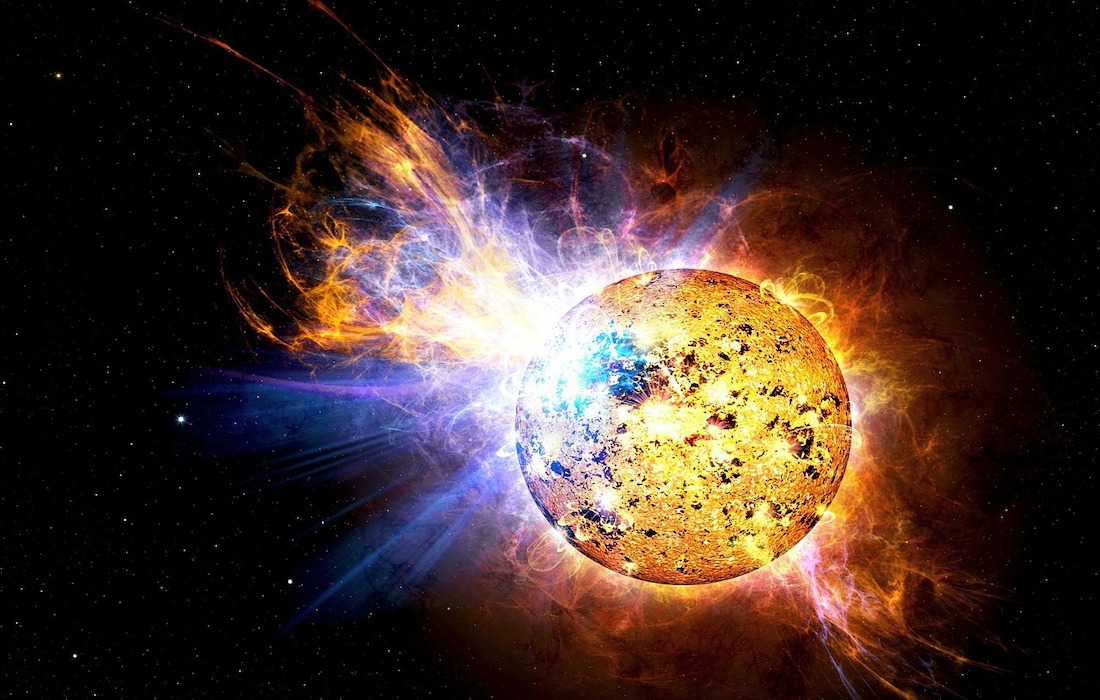
A Solar flare is a sudden flash, probably a bright light, on the Sun’s surface. If this sudden flash of brightness is seen on a star beside the Sun, the phenomenon is termed as a stellar flare. A vast amount of energy is released from a stellar or solar flare, typically on the order of 1 × 1025 joules, over a broad spectrum of wavelengths and particles. This massive amount of energy is comparable to the explosion of 1 billion megatons of TNT or ten million volcanic eruptions. A solar flare may eject atoms, electrons, and ions into space in what is called a coronal mass ejection, in addition to light. When the Sun releases particles, these particles reach Earth within a day or two. Fortunately, the mass may be ejected outward in any direction, so our planet is not affected always. Unfortunately, scientists are unable to forecast solar or stellar flares, only give a warning when one has occurred.
Like planets, stars consist of multiple layers. In the case of a solar or stellar flare, all layers of the Sun’s atmosphere are affected. Let’s understand this is in simple terms – energy is released from the photosphere, chromosphere, and corona. Flares tend to occur in regions of intense magnetic fields. These magnetic fields connect the atmosphere of the Sun to its interior. Flares are believed to be the result of a process called magnetic reconnection where loops of magnetic force break apart, rejoin and release energy. When magnetic energy is, all of a sudden, released by the corona, light and other space particles are accelerated into space.

The released matter’s source seems to be material from the unconnected helical magnetic field. However, scientists have not completely worked out how flares work and why there are sometimes more released particles than the amount within a coronal loop.
The ions, protons, and electrons gain velocity due to the intense energy to nearly the speed of light. From gamma rays to radio waves, electromagnetic radiation covers the entire spectrum. The released energy in the visible part of the spectrum makes some flares observable to the naked eye, but most of the energy is outside the visible range. These flares may also release a flare spray, which involves the release of material that is faster than a solar prominence. Particles released from a flare spray may attain a velocity of 20 to 200 Kmps. To put this into perspective, the speed of light is 299.7 Kmps.
How often do these flares occur?
Smaller flares occur more often than large solar flares. The frequency of any solar or stellar flare depends on the Sun’s activity There may be several flares per day during an active part 11-year solar cycle. There may be even 20 flares a day and over 100 per week during peak activity. Currently, scientists are not in the state to predict a solar flare with any rate of accuracy though they can guess it with high sunspot activity which is associated with the chance of flare production. The process of observing these kinds of a sunspot is called delta spots. These spots are used to calculate the probability of flare occurrence.