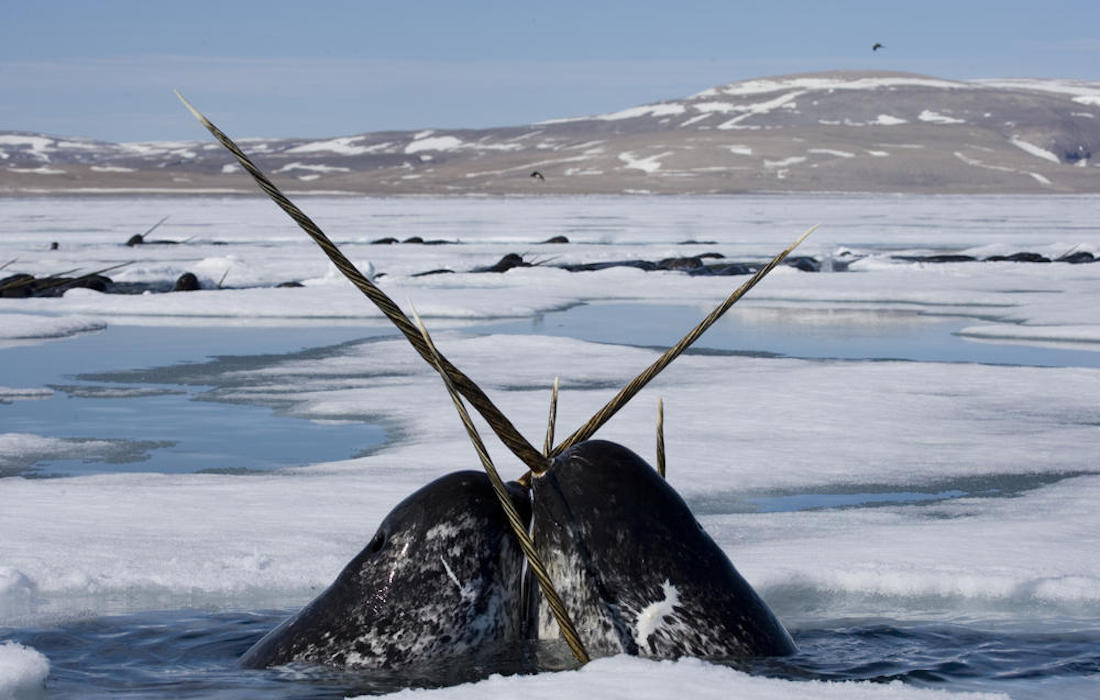
The history behind its name comes from the Norse word nar, which defines corpse, and the word whal is used for the whale. This unusual name refers to the mottled grey spots over the white color of the whale body. This whale very much resembles the drowned corpse and the meaning of its scientific name comes from the Greek phrase “one tooth one horn”. This sea creature is carnivorous with a life of 50 years.
The unicorn horn story
Let’s talk about the horn story of this beautiful sea creature. In male narwhal, there is a single long tusk which is actually hollow left-handed like spiral helix. This tusk grows from the left side of the jaw towards the whale’s lip. This tusk grows throughout the life of Narwhal. The average length of this tusk is 1.5 to 3.1 m which is 4.9 to 10.2 ft.
This little sea angel grows with a weight of approximately 10 kg. Only 1 in 500 male narwhal has two tusks, the grown tusk forms from the right canine tooth. Tusk of female narwhales are not as big as males and their tusk are less spiralized.
In previous theory, it was assumed that male tusks are used for sparring behavior but in the latest hypothesis, these tusks are used to communicate with each other. To communicate, they rub these tusks and they can send the information in the sea waters.
The other teeth of whales are vestigial and because of this, whales are essentially toothless in their appearance. That is why these whales are called “toothed whale”, as baleen plates are absent in these whales.
Behaviour and details of narwhals
Majorly all the narwhals are white in color and they are called as “white whales”. Though they are born with dark shades, but as they get older their skin color changes. Narwhals are born with no dorsal fin so that they can swim under the ice. These whales can become sexually mature between the age of 5 to 11 years. Narwhals body weight ranges between 800 kg to 1600 kg which is actually huge.
When it comes to behaviour, these whales are found in the pods of five to ten. These groups can be a combination of different sexes and ages. All these whales are found in artic sea and during summers, these whales can be found in the groups of thousands.
These whales can dive deep in the ice pack water during winters, and at the same time in summers they can go coastal. This beautiful creature can live as long as 50 years but mostly gets predated by humans, polar bears, and killer sharks. In total, approximately 7,50,000 Narwhals exist worldwide and we need to save them.