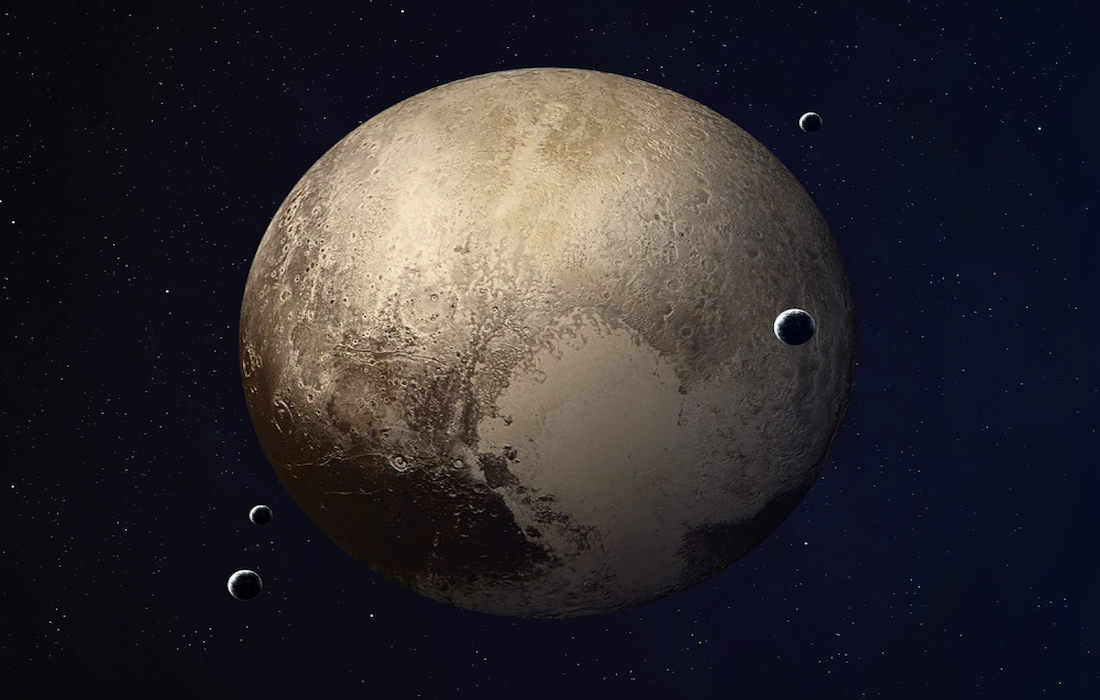
Pluto is a planet that continues to describe fascinating tales. Long ago when a small spacecraft passed through the system, the scientists concluded that Pluto had total five moons that were distant and mysterious. The scientists were on a mission to get a closer look at as many of these moons as possible in an effort to learn more about them and how these mysterious moons exist. As the spacecraft moved quickly, it captured close-up images of Pluto’s largest moon, Charon, and glimpses of the smaller ones too. These small moons of Pluto were named Styx, Nix, Kerberos, and Hydra. As these four smaller moons orbit in circular paths, meanwhile, Pluto and Charon orbit together like the bulls-eye of a target. Planetary scientists speculate that Pluto’s moons were established as a result of a titanic collision between at least two things that occurred in the distant past. Charon and Pluto settled into a locked orbit with each other, while the other smaller moons scattered out to more distant orbits.
Pluto’s Smaller MoonsStyx, Nyx, Hydra, and Kerberos are tiny moons that orbit within at least two times the range that Charon does from Pluto. All these smaller moons are oddly shaped, which lends confidence to the idea that they formed as part of a collision in Pluto’s history. One of these smaller moons, Styx, was discovered in 2012 as astronomers were using Hubble Space Telescope to search the system for moons and rings around Pluto. It appears to have an elongated shape and is about 3 by 4.3 miles.

Nyx was found in 2006 orbiting out near Styx, along with distant Hydra. Nyx is somewhat strangely shaped moon because of its dimensions i.e. 33-25-22 miles, and it takes nearly 25 days to make one orbit of Pluto. Nyx is supposed to have some of the same theolins as Charon spread across its surface.
Hydra is a smaller moon that is most distant of Pluto’s five moons, and New Horizons’ mission was able to get a fairly good image of the Hydra. There seem to be a few cavities on the lumpy surface of this tiny moon. Hydra measures about 34-25 miles and it takes Hydra roughly 39 days to make one orbit around Pluto.
Kerberos is the most mysterious-looking moon which looks lumpy and distorted in the New Horizons mission image. It appears to be a double-lobed tiny moon with dimensions of approximately 12 x 3 miles across. Kerberos takes just 5 days to complete one trip around Pluto.
How did these moons get their names?
Pluto is named after the God of the underworld according to traditional Greek mythology. Styx is the river that dead souls were supposed to cross to get to Hades, Nyx is the Greek goddess of darkness. Hydra is named after a many-headed serpent believed to have battled with the Greek hero Heracles. Kerberos is the so-called “hound of Hades” who guarded the gates to the underworld.
We hope you liked the information shared, cheers!