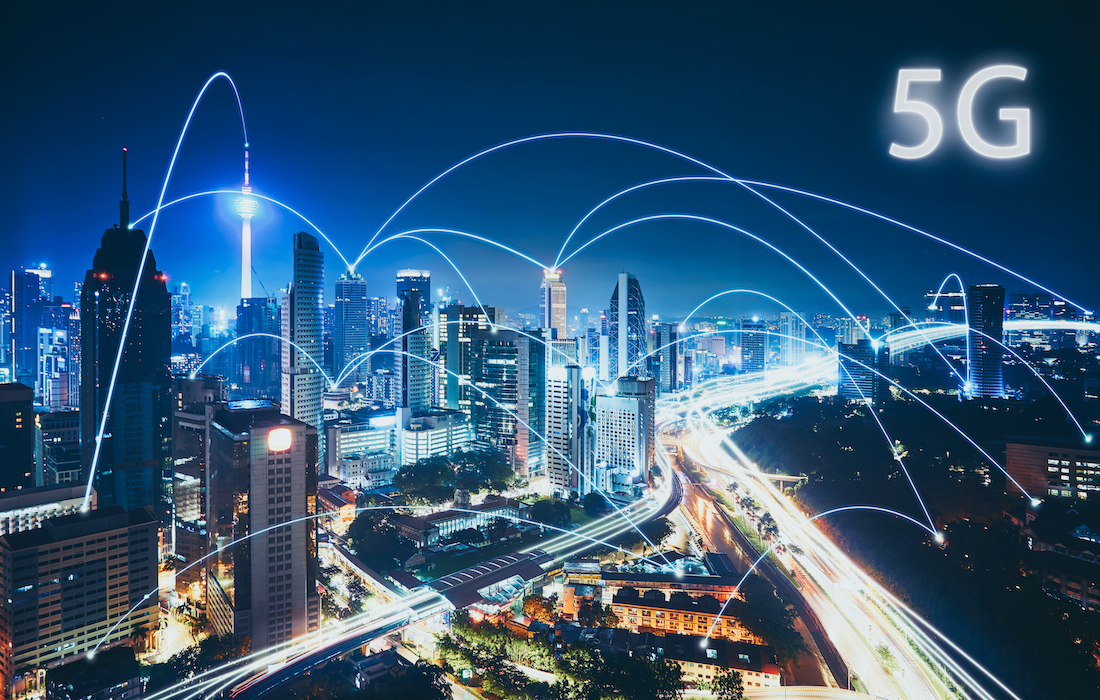
5G network, the next great leap in speed for wireless devices is the fifth generation of cellular technology. Mobile users can download data to their devices and enjoy un-interrupted streaming. The 5G network aims at delivering data rates that are 50 to 100 times faster than current 4G networks. People should expect to see download speeds on the order of GB per second (Gb/s). This is much greater than the tens of MBs per second (Mb/s) speeds of 4G.
Harish Krishnaswamy, an associate professor of electrical engineering at Columbia University in New York said, “That’s significant because it will enable new applications that are just not possible today.” “Let’s take an example; at GB per second data speeds, you could potentially download a movie to your phone or tablet in just a few seconds. Those types of data rates could enable virtual reality applications or autonomous driving cars.” Besides requiring high-speed data rates, emerging technologies and applications that interact with the user’s environment-like augmented reality will also require extremely low latency. The ultimate goal of the 5G network is to achieve latencies below the 1-ms (millisecond) mark. Smartphones will be able to send and receive data & information in less than one-1000th of a second, appearing wonderfully fast to the user. To accomplish these phenomenal speeds, the launch of the 5G network requires new infrastructure and technologies.
The futuristic network
Since the initial generations of mobiles, wireless networks have worked on the same radio-frequency bands of the electromagnetic spectrum. But as more users create the network crowded and demand more data than ever before, these radio-signal highways become extremely congested with cellular traffic. To compensate this thing, cellular network operators want to expand into the higher frequencies of millimeter waves.
Millimeter (MM) waves use frequencies from 30 GHz to 300 GHz, which are 50 to 100 times higher than the radio waves used nowadays for 4G networks and wireless networks. They are called millimeter waves because their wavelengths vary between 1 and 10 mm, whereas radio waves are on the order of cm.
The higher frequency of MM waves may create new lanes on the communication highway, but there’s one problem – Millimeter waves are easily absorbed by foliage and buildings and will require small cells (closely spaced base stations). Fortunately, these small cells are much smaller and require less power than traditional cell towers. They can be placed at the top of buildings and light poles.
Does 5G possess any danger?
Although the 5G network may improve our everyday life, some consumers have already started raising concerns about potential health hazards. Many of these concerns are over the 5G data network’s use of higher energy millimeter-wave radiation.
Kenneth Foster, a professor of bioengineering at Pennsylvania State University said, “There’s often confusion between ionizing and non-ionizing radiation because the term radiation is used for both”. Ionizing radiations are dangerous because they can break chemical bonds.”