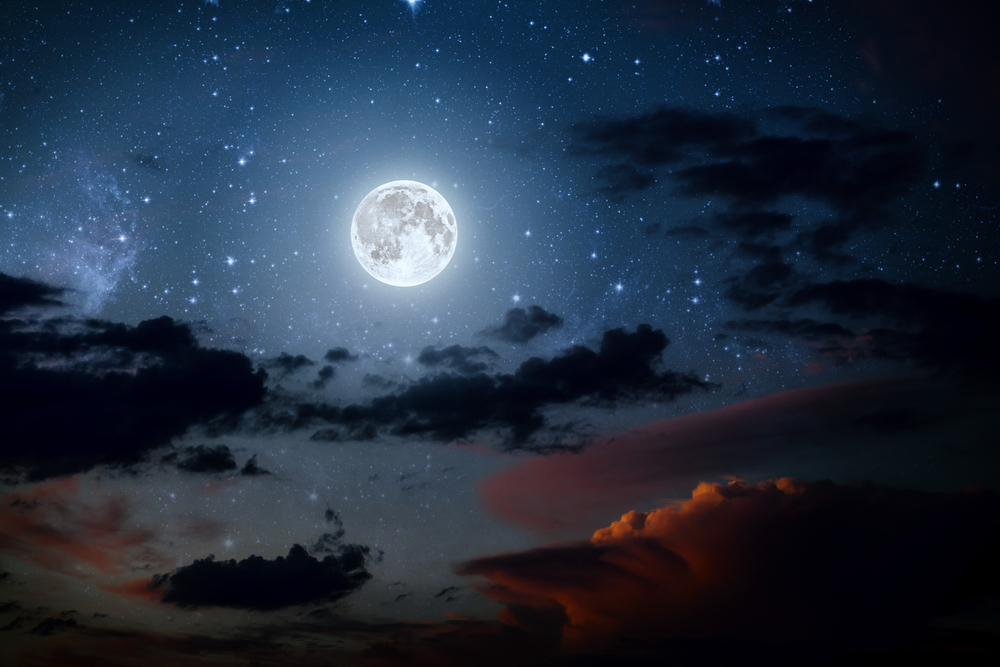
All generations of time have gazed up at the moon. The passage of “one moon” used to be the way people understood the passing of time. The moon goes through a series of phases that was used to determine how much time would pass until the next full moon. The name of the moon basically means month. It comes from the Old English word mona, and the Latin word metri which means month.
The moon has other names too. Like many of the other celestial bodies in the sky, the moon also has a name associated with Greek and Roman Mythology. Mars is named for the God of War, Venus the Goddess of Love and Beauty. The moon was named for the Goddess of the Moon, Luna. The word luna is Latin and is the origin of words we still use like “lunar” to describe things associated with space and the sky. In Greek, the name of the moon is “Selene” who was the Goddess of the Moon. We still use a derivative of this word, “selenology” to describe the study of the moon’s geology,
Before 1610, mankind only knew about our moon. But in that year when Galileo Galilei discovered small “moons” surrounding Jupiter, the name moon stuck as a way to describe the smaller satellites that orbit planets. So, it could be said that all other moons are actually named after our moon.
The new moons Galileo discovered were also given names from Greek and Roman mythology. For example, Jupiter’s moons were named Io, Europa, Ganymede and Callisto. Venus is the second brightest object in the sky next to the moon, but it does not have its own moon. Mercury can also be seen by the naked eye, and it also does not have a moon.
Astronomers are discovering new moons even today and the tradition of using Mythology has continued. In 2019, 20 more moons were discovered in Saturn’s orbit. Its 62 moons have Greek and Roman names such as Titan, Rhea, Dione, and Atlas.
It was in 1919 that our moon officially got its name when the International Astronomical Union, or IAU, was formed. Among their first acts was officially naming the moon. They chose to keep the name Moon because it was just simpler. That was the name that people had been using for generations and changing it then would have been confusing.
Despite its seemingly plain name, our planet’s moon is truly unique. The passing of months has been measured by its phases. Tides are caused by it. Wolf packs howl when it rises in the sky. Travelers use the moon’s light to guide their way. Writers have penned poems about it. And a few determined astronauts have even walked on its surface.