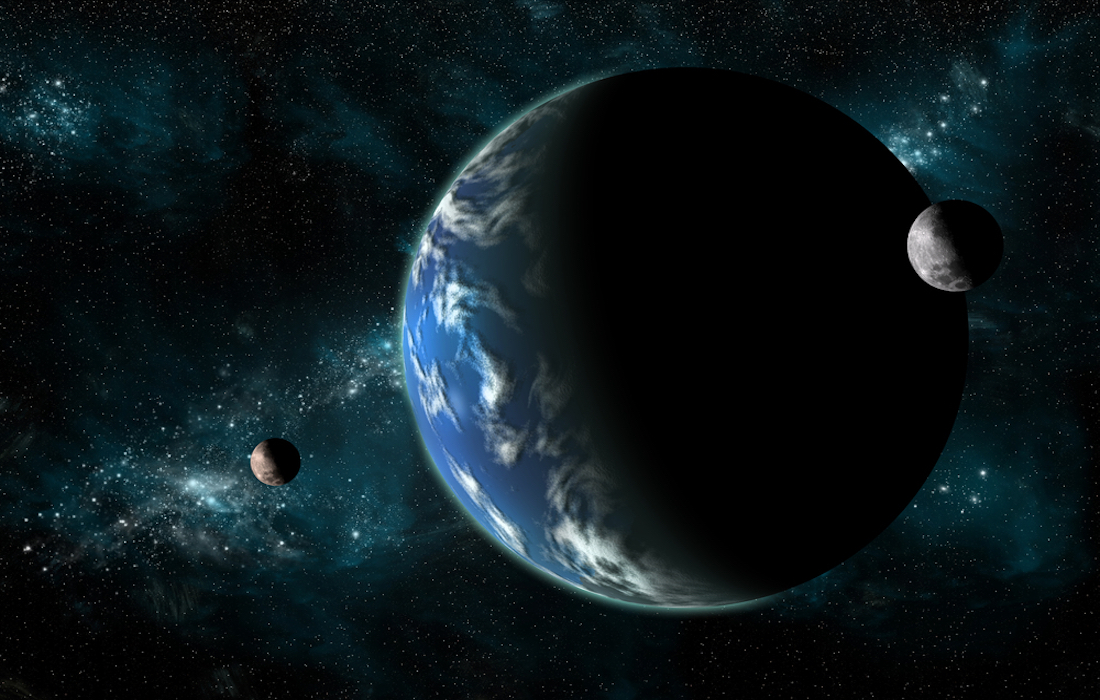
Claims have often been made that planet Earth has more than one moon. In the early 19th century, astronomers and NASA scientists have sought these other bodies. While the media channels or press release might refer to some of the discovered objects as our second or even third moon. But the reality is that we have one single moon only. To understand reality, let’s first understand what makes a moon, a moon.
What makes the moon, a moon?
A body of a moon must be a natural satellite in orbit around a planet in order to qualify as a true moon. Because a moon must be natural no artificial satellite or spacecraft orbiting the Earth should be called a moon. There are no restrictions on the moon’s size. Although, most people think of a moon as a round object, there are other smaller moons with irregular shapes. Yet even without a size restriction, there are not any objects that really orbit the Earth,
Earth Quasi-satellites
Whenever you read in an article on a newspaper or watch some news about tiny-moons or second moons, this usually refers to quasi-satellites. While quasi-satellites don’t orbit our planet, they are near the planet and orbit the Sun from the same distance away as us. Quasi-satellites are believed to be in 1:1 vibrancy with the Earth, but their orbit is not tied to the Earth’s gravity or even the Moon. If the moon and Earth get suddenly vanished, the orbits of these bodies would be largely unaffected.
Quasi-satellites examples include 2014 OL339, 2016 HO3, 2013 LX28, 2010 SO16, (277810) 2006 FV35, (164207) 2004 GU9, 2002 AA29, and 3753 Cruithne. Some of these quasi-satellites have staying power.

3753 Cruithne
Cruithne is the noteworthy object most often termed as Earth’s second moon and the one most likely to become one in the future. Cruithne is an asteroid having a width of approximately 5 kilometers, which was discovered in 1986. It’s a quasi-satellite that doesn’t orbit Earth but orbits Sun. But at the time of its discovery, its complex orbit made it appear that it might be something known as the true moon. Cruithne’s orbit is affected by Earth’s gravity, though. At present, the Earth and the asteroid return to about the same position relative to each other every year. Cruithne won’t collide with the Earth because its orbit is inclined to ours. In another 5,000 years or so, the Cruithne orbit will change. At that time, it might truly orbit the Earth and be recognized as a true moon. But still, it will only be a temporary moon, escaping after another 3,000 years.
Short-term Satellites
If you’re okay with a moon being a temporary visitor, then there are small objects continuously orbiting the Earth that might be considered as true moons. According to Mikael Ganvik, Robert Jedicke, and Jeremie Vaubaillon, who are astrophysicists, there is at least one natural object around 1-meter in diameter orbiting the Earth at any given time. Usually, these short-term moons remain in the orbit for several months before vanishing again or falling to our planet as a meteor.