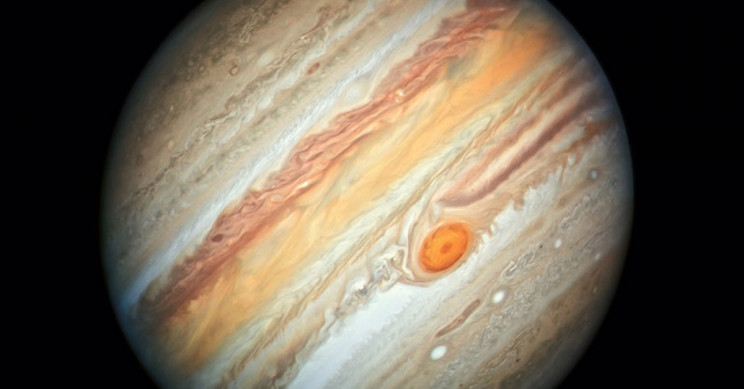
We all know from life as a teenager that when you have a big red spot the last thing you want is someone taking a photo of you. With that in mind, spare a thought for Jupiter. The poor planet has a massive red spot for centuries and at every advancement, in innovation, we continue to take more and more pictures of it. These latest photos though reveal more about it than we have ever known before.
The ‘Great Red Spot’ has been visible on the planet of Jupiter for centuries. It is so big that the Earth could fit inside its circumference almost three times. The ‘Great Red Spot’ is not acne attacking a planet but the largest storm in the solar system that has been raging for a long time. It has been part of Jupiter for an incredibly long time and is part of the planet’s undeniable beauty (and if you are a teenager with a big red spot, then hey, you are beautiful too, don’t worry).
The storm is believed to have first been spotted in 1665 when it was described by Cassini. This means that to date, we know that the storm has existed for over 340 years but it may be much longer.
Although we have been looking at this giant pimple for years we have never known much about it. However, a new approach to planet imaging has meant we now have a new view of the spot. Hubble Space Telescope is working with Gemini Observatory and Juno spacecraft to take images of Jupiter at a level of clarity that has never bee seen before. Jupiter generally has strange atmospheric conditions that can make taking photographs difficult. The team working at Gemini Observatory was able to overcome this using something that they call ‘lucky imaging’ where the camera basically reacts to Jupiter’s atmosphere and when there are minimal disruptions it takes the clearest pictures.
The ‘Big Red Spot’ has always been visible but never with such clarity. For years scientists have seen black circles on the Big Red Spot but until now could not understand what they were. The latest images reveal these blacks spots are in fact large holes in the clouds and not alternative types of clouds as was previously believed.
The discovery may only be a small one but it highlights the new approach to space exploration and the potential benefits it may reap. If either Hubble, Gemini, or Juno had worked on this project alone they would not have had the capabilities or knowledge to make this realization. Today, partly because of funding cuts and partly because of wanting to take advantage of the best each has to offer, collaboration is becoming a key part of space exploration.
These detailed photographs may start to reap many more rewards soon. From these pictures, scientists may be able to tell if there is what on Jupiter and what elements comprise the atmosphere. Already it has been discovered from ground-based satellites that there is more oxygen on Jupiter than the sun. The main task of Juno is to find water and with the help of Gemini and Hubble, it may be possible.
At a period of such uncertainty within our own planet, it is exciting to see space institutes working together to continue to discover more about the world beyond our atmosphere. Jupiter is the largest planet in our solar system and one that at present poses more questions than answers. Using advanced technologies and collaboration we may be able to answer some of those questions. Until then, we should at least try not to stare too much at Jupiter’s Big Red Spot, it may be self-conscious about it after all.