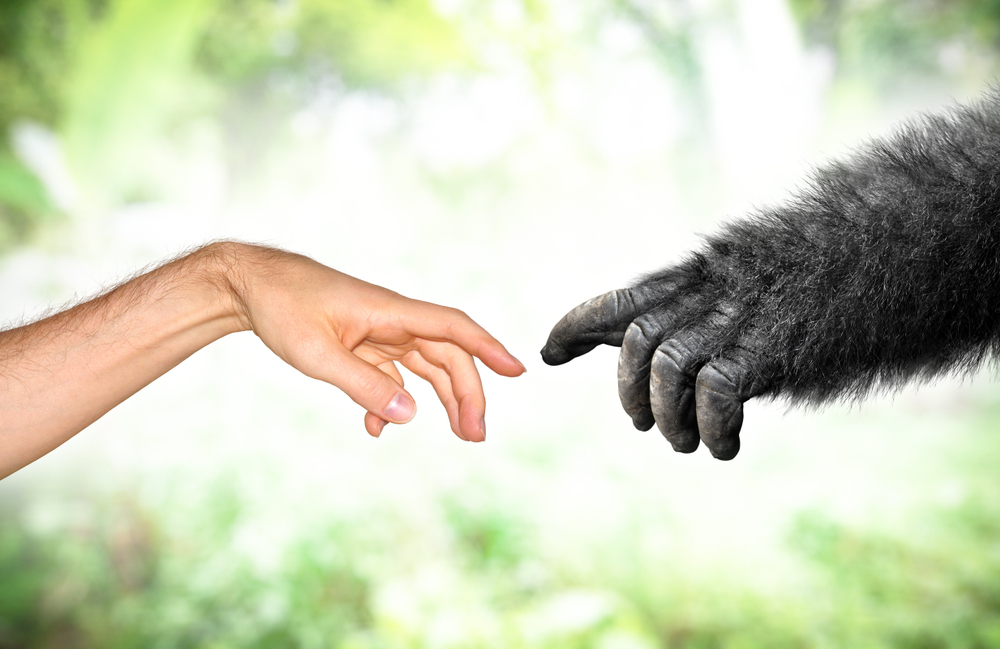
How did we lose all the hair being social animals while other primates are furry and hairy? Many compelling theories have been developed over a period of time to make us understand this.
The aquatic ape hypothesis
The aquatic ape hypothesis was first developed by a pathologist named Max Westenhöfer in 1942. But this idea became popular in the 1960s when it was adopted by a marine biologist Alister Hardy, a zoologist Desmond Morris and a writer Elaine Morgan. The theory explains that during a brief period in our evolution, our preceding generations enjoyed a semi-aquatic existence, that is, they lived near the water and spent a great deal of their time swimming, diving for food, and wading.
Further, in support of this theory, the protagonists explain that we shed our hair and, in exchange, added a layer of fat on our body like the marine mammals. No doubt that the theory has been discredited as there is no evidence like a fossil record to prove the theory.
The study of human and lice genetics
Another theory fell in place when the study of human and lice genetics produced evidence that our ancestors lost their hair a million years ago while living in Africa Savanna. Due to the location and climate of the area, evolutionary biologists opined that running around and sweating has caused the ancestors to shed their heavy hair in this hot climate. This was done to promote cooling by facilitating perspiration.
This theory also had some holes in it. In the Africa Savanna, there lived a species of monkeys around the same time they are very hairy in today’s time. Also, the fact that less hair may be good during the day to keep it cool, at night, it will be challenging to stay warm. The hypothesis did not include our nearest relative chimpanzee that has less hair. Looking at the size of the primate, they have very little hair, and rather than living in the hot Savanna, they resided in the cooler jungles.
A very popular theory was that we shed our hair in the past to make it less attractive for the little bugs and creepy crawlers that might feast on our blood and spread diseases. But this is an arguable theory as bare skin is more feast to such parasites. It is an invitation to the lice to be our mate.
A theory that is gaining more attention lately is that we lost our hair to facilitate better communication. We can signal by the facets of our skin and expressions on our faces. An anthropologist Barbara King described our skin as ‘Canvas.’